
English Phrases in General (1)
By: Mohammad Ali Ghoveh Nodoushan/ Lingoneed
1. Adjectives
An adjective (ADJ) describes or gives information about a noun or pronoun. It can tell us what someone or something is like, which one is meant, or how many or how much. In the patterns on the original page, the key structure is an article or determiner followed by an adjective and then a noun.
1.1 The pattern: a / the + adjective + noun
A common noun phrase has this order: article + adjective + noun. The adjective comes before the noun it describes.
· a beautiful city
· a difficult question
· the happiest boy
· the most beautiful city
The original sheet highlights that the adjective can be in the comparative or superlative form. The word the is commonly used before a superlative adjective.
1.2 Comparative adjectives
Comparative adjectives compare two people, things, places, or situations. Short adjectives often take -er; longer adjectives usually use more. Than is often used to introduce the second item in the comparison.
· Ali is taller than Reza.
· This exercise is easier than the previous one.
· This book is more interesting than that one.
Comparative adjectives can also appear in noun phrases, for example: “the taller boy” (the boy who is taller, in a context where two or more boys are being compared). The definite article is not required for every comparative: “a better solution” is also correct.
1.3 Superlative adjectives
Superlative adjectives identify the highest or lowest degree within a group. Short adjectives often take -est; longer adjectives generally use most or least. The is normally used before a superlative when the adjective modifies a noun.
· She is the tallest student in the class.
· That was the most difficult question.
· It is the least expensive option.
Common spelling changes include: happy → happier → happiest; big → bigger → biggest; beautiful → more beautiful → most beautiful. Some forms are irregular: good → better → best; bad → worse → worst; far → farther/further → farthest/furthest.
1.4 Present and past participles used as adjectives
The -ing (present participle) and -ed or other past-participle forms of verbs can function as adjectives. They describe nouns, but their meanings are often different.
An -ing adjective commonly describes the person or thing that causes a feeling or produces an effect. An -ed adjective commonly describes the person or thing that experiences the feeling or effect.
· The developing countries need investment. (developing describes countries)
· The film was exciting. (the film caused excitement)
· The audience was excited. (the audience experienced excitement)
· We visited a settled area. (settled describes the area)
Other pairs: interesting / interested; boring / bored; confusing / confused; tiring / tired. This is a useful tendency, not a rule that explains every participial adjective.
2. NOT and Negation
The original page points out that NOT is not included in the listed sentence patterns because it can be added to many different sentence structures to make them negative. It does not normally change the basic word order of the sentence; it is placed in the appropriate position for the auxiliary or verb structure.
2.1 NOT with BE
· She is happy. → She is not happy.
· They were ready. → They were not ready.
· It is possible, but it is not probable.
2.2 NOT with auxiliary verbs
· I can swim. → I cannot swim. / I can't swim.
· She has finished. → She has not finished.
· They will come. → They will not come.
2.3 NOT in the present and past simple
When there is no auxiliary verb in the affirmative present simple or past simple, English normally uses do/does/did + not + base form of the main verb.
· He works here. → He does not work here.
· They like coffee. → They do not like coffee.
· She arrived early. → She did not arrive early. (not: did not arrived)
Avoid using two negatives in standard formal English when one negative is intended: “I don't know anything” is standard; “I don't know nothing” is nonstandard in many varieties of English.
3. Question Word Order
The original page says that the sentence patterns can usually still help with questions, even though the patterns are presented mainly as statements. To understand a question, identify its underlying sentence structure and then apply the relevant question formation rule.
3.1 Yes/no questions
When a sentence has BE or a modal/auxiliary verb, that verb usually moves before the subject.
· You are ready. → Are you ready?
· She can drive. → Can she drive?
· They have finished. → Have they finished?
With a main verb in the present simple or past simple, use do, does, or did before the subject.
· You like English. → Do you like English?
· He lives here. → Does he live here?
· They arrived early. → Did they arrive early?
3.2 Wh-questions
Wh-questions begin with a question word such as what, where, when, why, who, which, or how. When the question word asks about an object or other information, the usual order is question word + auxiliary + subject + main verb.
· What do you study?
· Where does she work?
· Why did they leave?
· How can we solve this problem?
3.3 Change the question into a statement
The source recommends temporarily turning a question into a statement. This makes it easier to see the grammatical role of the missing information. For example:
Question: What are you majoring in?
Statement-like order: You are majoring in what?
In the statement-like version, “You” is the subject, “are majoring” is the verb phrase, and “in what” is a prepositional phrase. The preposition in remains at the end of the natural question in everyday English. This is called preposition stranding.
A more formal alternative is “In what are you majoring?” but it is less common in ordinary conversation. The natural everyday question is “What are you majoring in?”
4. Omission of Words (Ellipsis)
English sometimes leaves out words when the meaning is clear from the surrounding context. This is called ellipsis. The omitted words are understood even though they are not spoken or written.
The original example is: “It's possible, but (it is) not probable.” The words “it is” are understood after but, so the shorter version avoids repeating them.
4.1 More examples
· She can play the piano, and he can (play the piano), too.
· Some students chose tea; others (chose) coffee.
· I ordered the chicken, and my friend (ordered) the fish.
· Are you ready? — Yes, I am (ready).
Ellipsis is common in conversation and coordinated clauses. However, words should only be omitted when the intended meaning remains clear and the resulting sentence is grammatically acceptable.
5. Symbols Used in the Patterns
5.1 Parentheses ( ) = optional
Parentheses show that an element may be included or omitted without making the pattern invalid.
· She (often) visits her grandparents.
· The meeting (will) start at nine.
The exact acceptability depends on the particular pattern and meaning; parentheses in a grammar formula simply mark an optional element.
5.2 Braces { } = choose one item
Braces group alternatives. Choose one of the listed items for a particular use; do not use all alternatives together unless the sentence independently requires them.
Example pattern: {a / the} + adjective + noun
Possible noun phrases: “a useful book” or “the useful book.”
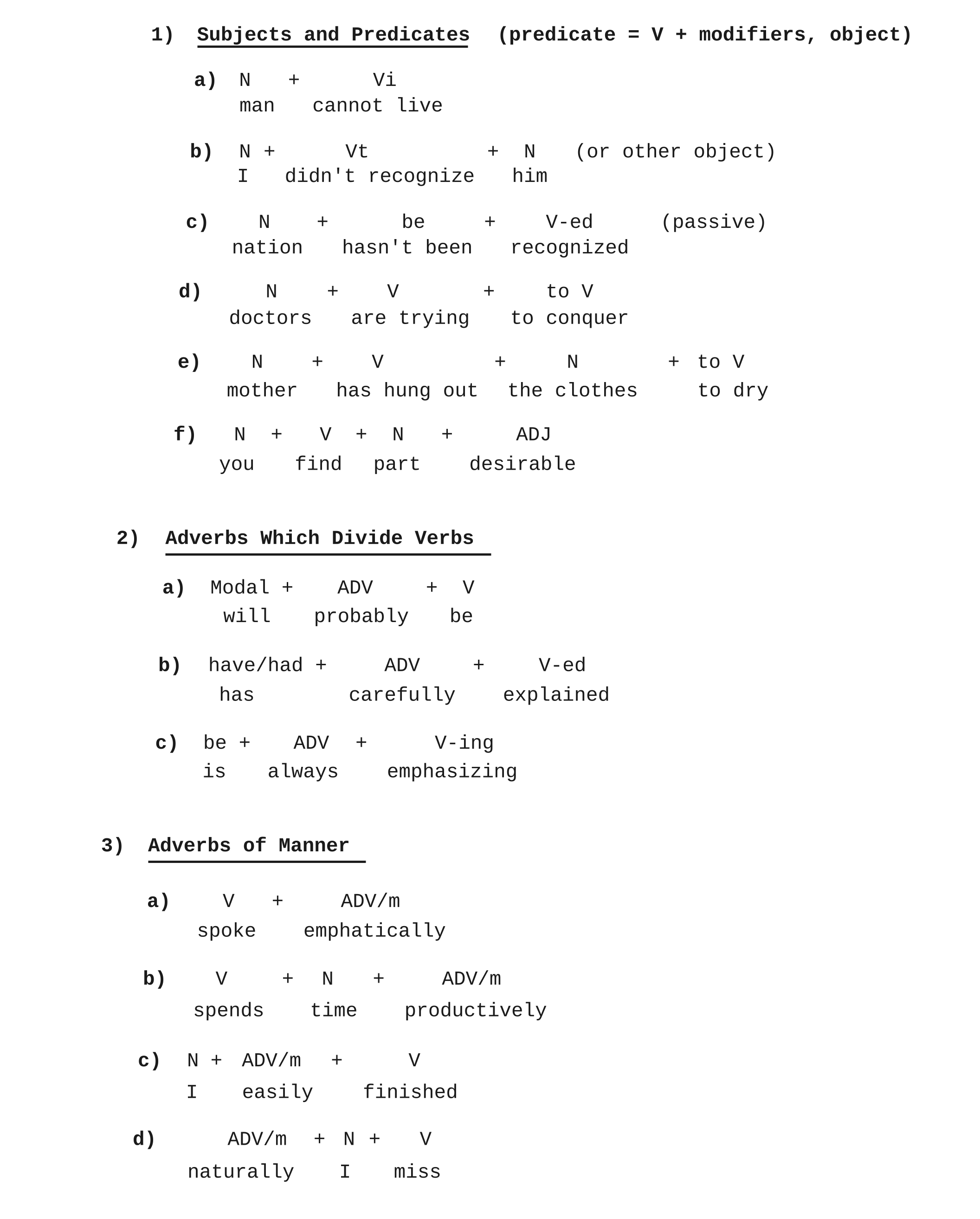
5.3 N = noun or noun phrase
In the source, N is used broadly. It can represent a single noun, a pronoun, or a complete noun phrase with describing words before or after its main noun. It can also represent an object that is expressed by a longer clause in some patterns.
· Noun: Students need practice.
· Pronoun: They need practice.
· Noun phrase with words before the noun: The two young students need practice.
· Noun phrase with a phrase after the noun: The students in my class need practice.
· Noun phrase with a relative clause: The book that you recommended is excellent.
A subject (S) is the person or thing the clause is about; a verb (V) expresses the action or state. In “The students who arrived early found their seats,” the subject is a noun phrase containing a relative clause: “The students who arrived early.”
6. Integrated Examples
The most interesting book is on the table.
The most interesting = article + superlative adjective phrase + noun; on the table = prepositional phrase.
The lesson was confusing, but the students were not confused.
Confusing describes what caused confusion; confused describes how the students felt. NOT makes the second clause negative.
What did the teacher explain?
Question word + did + subject + base-form verb. The statement order is: The teacher explained what.
It's useful, but (it is) not essential.
The words it is are omitted after but; NOT makes the adjective phrase negative.
The students in the library are preparing for the exam.
The students in the library is a noun phrase; in the library is a prepositional phrase.