
English Phrases in General (2)
By: Mohammad Ali Ghoveh Nodoushan/ Lingoneed
Detailed Explanation and Examples
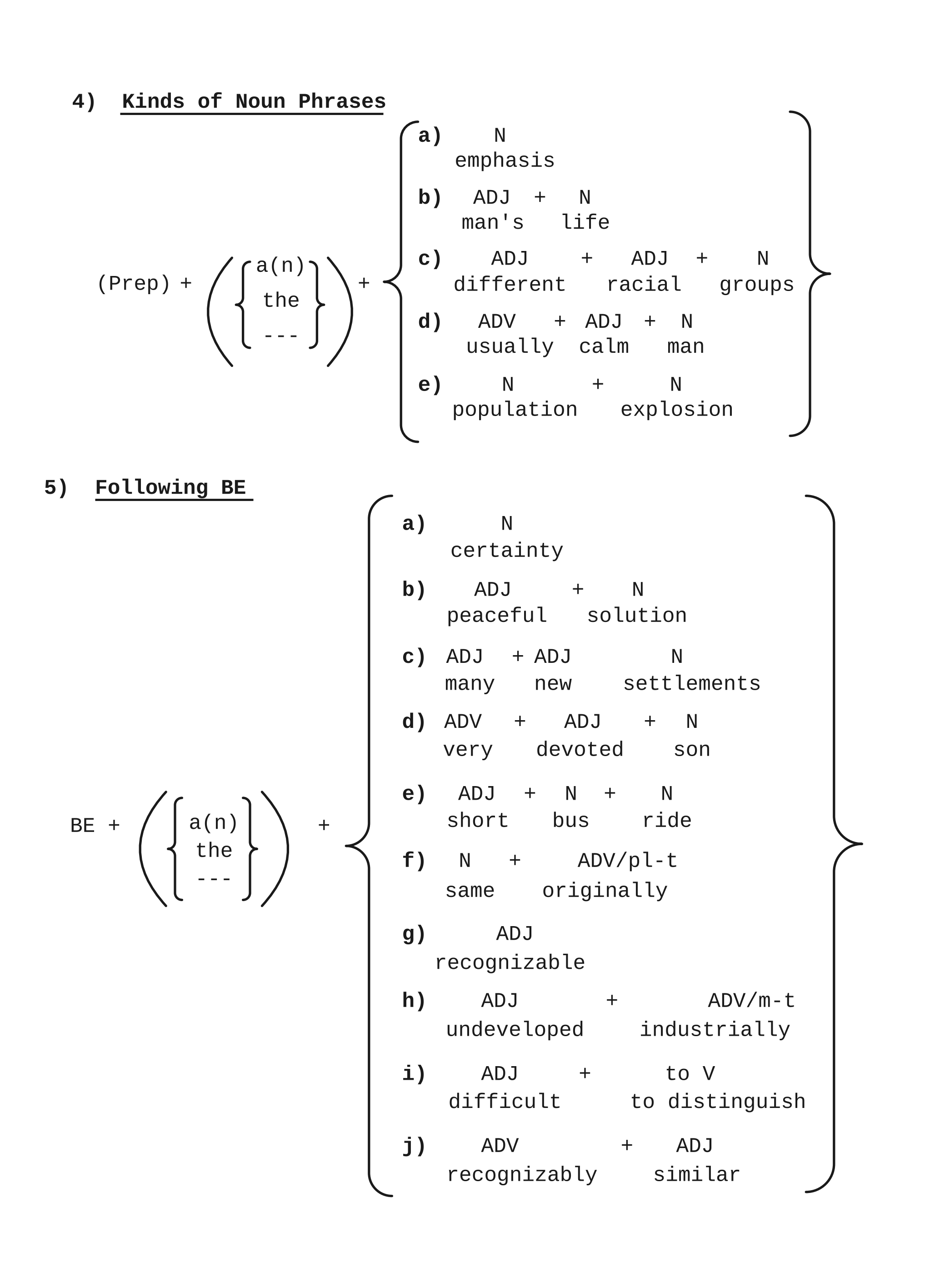
These two patterns deal with noun phrases (a noun plus the words that go with it) and with what can follow the verb be. Pattern 4 gives the building blocks; pattern 5 shows which of those blocks, and which other structures, can come after be.
How to read the formulas
| Symbol | Meaning |
|---|---|
| ( ) | Optional. The item may be left out: (Prep) means a preposition may or may not be there. |
| { } with stacked lines | Choose exactly one of the stacked items (the big curly brace). |
| a(n) / the / --- | Choose one: the indefinite article a (before a consonant sound) or an (before a vowel sound), the definite article the, or no article at all. The dashes --- mean “zero article”. |
| + | Followed by. |
| Prep | Preposition: in, on, of, with, for, among, … |
| BE | Any form of be: am, is, are, was, were, be, been, being. |
| N, ADJ, ADV, to V | Noun, adjective, adverb, to-infinitive (as on the first sheet). |
| ADV/pl-t | The sheet does not define “pl-t”. In the example (originally) it is best read as an adverb of place or time. |
| ADV/m-t | The sheet does not define “m-t”. In the example (industrially) it is an adverb of manner that says in which respect something is true (“in industrial terms”). |
4) Kinds of Noun Phrases
A noun phrase (NP) is a noun together with its article and modifiers. It can be a subject (Population growth is rapid), an object (She studies racial groups), the object of a preposition (in man’s life) or a complement after be.
The formula reads: an optional preposition, then one of three article choices (a/an, the, or none), then one of five noun-phrase shapes. Some complete phrases built from it:
| Choices | Result |
|---|---|
| no Prep + --- + N | emphasis |
| Prep (for) + --- + N | for emphasis |
| Prep (in) + --- + ADJ + N | in man’s life |
| Prep (among) + --- + ADJ + ADJ + N | among different racial groups |
| Prep (of) + the + ADV + ADJ + N | of the usually calm man |
| Prep (in) + a + N + N | in a population explosion |
When do you use a(n), the or no article?
• a / an: a singular countable noun that is not specific or is mentioned for the first time. Use a before a consonant sound (a man, a university, a usually calm man) and an before a vowel sound (an hour, an explosion, an extremely calm man). The choice depends on the first word after the article, not on the noun.
• the: something specific, already known, unique or identified: the emphasis on grammar, the sun.
• --- (no article): plural countable nouns used in general (groups, doctors), uncountable nouns (emphasis, life, certainty), and names (Berlin, Maria).
4a) N — a noun alone
N emphasis
The simplest noun phrase is a bare noun. This works with uncountable nouns, plural nouns and names. A singular countable noun cannot stand alone; it needs an article or a possessive (a doctor, my doctor, not “doctor”).
Examples
• Emphasis is needed here. (uncountable, no article)
• The teacher put emphasis on grammar.
• We did it for emphasis. (Prep + N)
• Doctors help people. (plural, no article)
• The emphasis is on speed. / An emphasis on speed is new. (with the / an)
4b) ADJ + N — adjective + noun
ADJ + N man's + life
An adjective comes before the noun it describes. It does not change for singular or plural (a red car, red cars). In the sheet, man’s is a possessive noun; possessives take the place of an adjective or article in the noun phrase.
Examples
• man’s life → in man’s life; a man’s life; the man’s life
• a good idea
• the red car
• in cold weather
• with great care
Notes
• A possessive normally replaces the article: my life, John’s car, not “the my life”. But the article belongs to the possessive noun in a man’s life, the man’s life.
• To show possession on a singular noun add ’s (man’s); on a regular plural add only an apostrophe (the doctors’ room).
4c) ADJ + ADJ + N — two adjectives
ADJ + ADJ + N different + racial + groups
Two adjectives can stand before the noun. The order is not random: general or opinion adjectives come first and classifying adjectives (the ones that say what kind of thing it is) come last, next to the noun. Here different is general and racial classifies the groups.
Examples
• different racial groups
• a beautiful old house
• a small red car
• a long hot summer
• in many small villages
Notes
• Usual order: opinion → size → age → shape → colour → origin → material → purpose. a lovely small old wooden box
• Comma test: if you can put “and” between the adjectives or swap them, use a comma: a cold, wet day. If not, no comma: different racial groups.
4d) ADV + ADJ + N — adverb modifying the adjective
ADV + ADJ + N usually + calm + man
An adverb can come before an adjective to modify the adjective, not the noun. A usually calm man is a man who is usually calm. Use an adverb (ending in -ly), not an adjective, here.
Examples
• a usually calm man
• a very tall man
• an extremely difficult exam
• the surprisingly good result
• her unusually quiet voice
Notes
• Typical adverbs of degree: very, quite, rather, fairly, extremely, really, surprisingly, unusually.
• Incorrect: a very calmly man. Correct: a very calm man (the word before the noun must be an adjective).
• “usually” begins with a y sound, so the article is a (a usually calm man).
4e) N + N — noun + noun
N + N population + explosion
A noun can act like an adjective in front of another noun. The first noun classifies the second: a population explosion is an explosion of population. This is called a noun adjunct or compound noun.
Examples
• population explosion
• a bus driver
• the city centre
• a computer screen
• a shoe shop
Notes
• The first noun is normally singular even when the meaning is plural: a shoe shop (not “a shoes shop”). A few exceptions exist: sports car, customs officer.
• Compounds may be one word (toothbrush), hyphenated (mother-in-law) or two words (bus stop); check a dictionary.
• Words can be combined: a rapid population explosion; in a surprisingly rapid population explosion. The sheet shows the options separately, but real phrases often mix them.
5) Following BE
Be is a linking verb: it does not describe an action, it connects the subject with a complement that identifies or describes it. The formula says: BE + (a / the / no article) + one of ten possibilities.
Forms of be
• am, is, are (present); was, were (past); been (participle: has been); being (-ing form); be (base form: will be, to be).
Overview
• 5a–5e: a noun phrase follows be (it identifies or classifies the subject).
• 5f: a noun plus an adverb of place or time.
• 5g–5j: an adjective or adjective phrase follows be (it describes the subject).
• The article slot only matters when a noun follows (5a–5f). With adjective-only patterns (5g–5j) there is no article.
5a) BE + N
BE + N is + certainty
The noun identifies or classifies the subject. A singular countable noun needs a(n) or the; plural and uncountable nouns can stand without an article.
Examples
• He is a doctor. (singular countable → a)
• They are teachers. (plural → no article)
• This is the answer.
• Time is money. (uncountable → no article)
• Death is a certainty. (a certainty = something sure to happen)
Notes
• Incorrect: She is teacher. Correct: She is a teacher.
• certainty is uncountable in general (Certainty is rare) but countable when it means a sure thing (a certainty).
5b) BE + ADJ + N
BE + ADJ + N is + a + peaceful + solution
An adjective inside the noun phrase describes the noun, and the whole phrase classifies the subject.
Examples
• This is a peaceful solution.
• It was a long day.
• They are good friends.
• She is the new manager.
Notes
• Compare: The solution is peaceful (5g, adjective alone, describes) with It is a peaceful solution (5b, classifies it as a kind of solution).
5c) BE + ADJ + ADJ + N
BE + ADJ + ADJ + N are + many + new + settlements
Two adjectives (or a quantity word plus an adjective) before the noun. The sheet counts many as an adjective; grammatically it is a quantifier.
Examples
• There are many new settlements in the region.
• They are two old friends.
• These were difficult, tiring days.
• That is a small blue car.
Notes
• With there + be, the real subject comes after be and be agrees with it: There is a new settlement. / There are many new settlements.
• Incorrect: There is many new settlements.
5d) BE + ADV + ADJ + N
BE + ADV + ADJ + N is + a + very + devoted + son
Same as 4d after be: the adverb modifies the adjective (very devoted), and the whole phrase describes the subject.
Examples
• He is a very devoted son.
• She is an extremely talented musician.
• It was a rather boring film.
• They are quite good friends.
Notes
• Incorrect: He is very devoted son. Correct: He is a very devoted son (a singular noun needs an article).
5e) BE + ADJ + N + N
BE + ADJ + N + N is + a + short + bus + ride
An adjective plus a noun compound (see 4e). The adjective describes the whole compound: a short bus ride.
Examples
• It was a short bus ride.
• This is a new computer screen.
• She is the senior sales manager.
Notes
• Numbers with a noun adjunct use the singular and a hyphen: a ten-minute bus ride (not “ten-minutes”).
5f) BE + N + ADV/pl-t — noun + adverb of place or time
BE + N + ADV/pl-t were + the + same + originally
After the noun, an adverb tells where or when the statement is true. In the sheet’s example, same works as a noun (the same) and originally says at what time: at first.
Examples
• The two words were the same originally.
• She is the manager here.
• The concert is the main event tonight.
• He was the leader then.
Notes
• “Same” is always used with the: the same (not “same” alone).
• The abbreviation “pl-t” is not explained on the sheet; I have read it as place/time.
5g) BE + ADJ — adjective alone
BE + ADJ is + recognizable
The adjective describes the subject directly. No article is used.
Examples
• The building is recognizable.
• She is happy.
• The soup was hot.
• They were tired.
Notes
• Some adjectives are used almost only after be or similar verbs: afraid, alone, asleep, alive, aware. Say The child is asleep, not “the asleep child”.
• Spelling: recognize + -able → recognizable (the final -e is dropped).
5h) BE + ADJ + ADV/m-t — adjective + adverb of respect
BE + ADJ + ADV/m-t is + undeveloped + industrially
The adverb follows the adjective and says in which respect it is true. The country is undeveloped industrially means it is undeveloped in terms of industry.
Examples
• The region is undeveloped industrially.
• The country is poor economically.
• The team is strong defensively.
• The plan is sound financially.
Notes
• This sounds formal or academic. The adverb can also come before the adjective: The country is industrially undeveloped. (compare 5j)
• The abbreviation “m-t” is not explained on the sheet; I have read it as an adverb of manner/respect.
5i) BE + ADJ + to V — adjective + to-infinitive
BE + ADJ + to V is + difficult + to distinguish
Some adjectives are followed by a to-infinitive. There are two different groups.
Group 1: ease, difficulty, evaluation (the sheet’s example)
Adjectives: easy, difficult, hard, impossible, safe, pleasant, good. The subject is the logical object of the infinitive: The twins are difficult to distinguish = It is difficult to distinguish the twins.
• This exercise is easy to do.
• The instructions are hard to follow.
• The water is safe to drink.
• Incorrect: The twins are difficult to distinguish them. (do not repeat the object)
Group 2: feeling, ability, likelihood
Adjectives: glad, happy, sorry, eager, ready, able, likely, afraid, surprised. Here the subject does the action of the infinitive.
• I am glad to see you.
• She is eager to learn.
• He is able to swim.
• They are likely to win.
5j) BE + ADV + ADJ — adverb + adjective
BE + ADV + ADJ are + recognizably + similar
An adverb in front of the adjective modifies it, as in 4d but without a noun after it. Recognizably similar means similar in a way that can be recognized.
Examples
• The two designs are recognizably similar.
• She is extremely tired.
• The results are strikingly similar.
• It was surprisingly easy.
Notes
• Use an adverb, not an adjective, to modify an adjective: really good, not “real good” (in careful writing).
• Compare 5g and 5j: The building is recognizable (adjective) / The buildings are recognizably similar (adverb + adjective).
Quick reference
| Pattern | Example | |
|---|---|---|
| 4a | (Prep) + article + N | for emphasis |
| 4b | (Prep) + article + ADJ + N | in man’s life |
| 4c | (Prep) + article + ADJ + ADJ + N | among different racial groups |
| 4d | (Prep) + article + ADV + ADJ + N | a usually calm man |
| 4e | (Prep) + article + N + N | a population explosion |
| 5a | BE + (article) + N | Death is a certainty. |
| 5b | BE + (article) + ADJ + N | It is a peaceful solution. |
| 5c | BE + (article) + ADJ + ADJ + N | There are many new settlements. |
| 5d | BE + (article) + ADV + ADJ + N | He is a very devoted son. |
| 5e | BE + (article) + ADJ + N + N | It was a short bus ride. |
| 5f | BE + (article) + N + ADV/pl-t | The words were the same originally. |
| 5g | BE + ADJ | The building is recognizable. |
| 5h | BE + ADJ + ADV/m-t | The region is undeveloped industrially. |
| 5i | BE + ADJ + to V | The twins are difficult to distinguish. |
| 5j | BE + ADV + ADJ | The designs are recognizably similar. |